St George’s Day 2026 falls on Thursday, April 23, 2026. It is England’s national day, but it is not a public holiday. That is the simple answer. The more interesting one is why a date that once felt ceremonial now carries so much emotional charge.
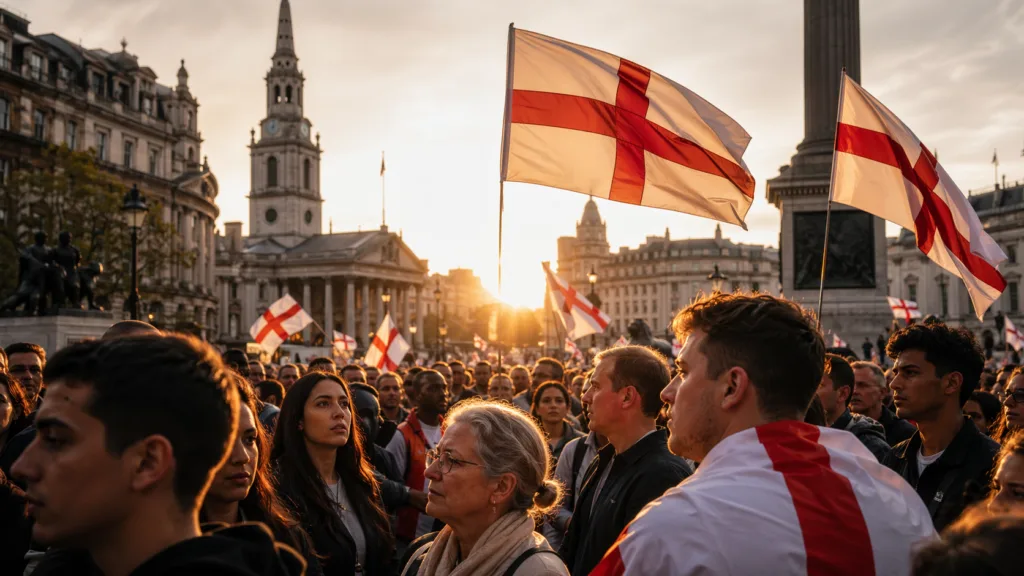
Every April, searches for st. george’s day, when is st george’s day, and why is st george’s day celebrated spike across England. In 2026, that curiosity lands in a different climate. The flag feels heavier. The conversation feels sharper. And st george’s day 2026 no longer sits in the calendar as a harmless ritual.
It sits there as an argument.
When is St George’s Day 2026?
If your main question is when is st george’s day 2026, the answer is straightforward: Thursday, April 23, 2026. According to Time and Date, it is a local observance in the United Kingdom rather than a public holiday.
If you are searching when is st georges day 2026, it is the same date: Thursday, April 23, 2026.
And if you are simply asking when is st george’s day or when is st georges day, the day is observed on April 23 each year, marking the anniversary of Saint George’s death in AD 303.
That clarity matters because search traffic around this topic is split. Some readers want the calendar answer. Others want context. The strongest article has to do both.
Why is St George’s Day celebrated?
Ask why is st george’s day celebrated, and the historical answer is clean: the day honours Saint George, the patron saint of England. He is remembered as a Christian martyr, a soldier, and later a symbol of courage, faith and moral defiance.
But the national story is more interesting than the textbook one.
Saint George was not English. England adopted him. That matters. It means English identity, even in one of its oldest rituals, has always involved choice, symbolism and imagination, not just ancestry. The country selected a figure who stood for bravery and sacrifice, then built him into its emotional vocabulary.
That is one reason saint george’s day still matters. It is not only a church date or a historical curiosity. It is one of the few moments when England tries to say something public about itself.
Who was Saint George, really?
The legend is familiar: a dragon, a princess, a rescue, a victory. But behind the myth, saint george is generally understood as an early Christian martyr who served in the Roman army and was executed for his faith.
Over centuries, the dragon story eclipsed the man. That is how saints enter national mythology. They stop being only historical figures and become symbols cultures can reuse. In England, saint georges day became attached to ideals of courage, Christian memory and patriotic ritual, even as public confidence about Englishness itself rose and fell around it.
That symbolic flexibility is exactly why the day still matters in 2026.
Why St George’s Day 2026 feels sharper than usual
This year, st george day lands in an England that is far more sensitive to identity than it was even a few years ago.
There is a visible push to reclaim the St George’s Cross as a symbol of civic belonging rather than resentment. Reporting from The Guardian on April 23, 2026, showed community and faith leaders using St George’s Day events to counter hatred and present the flag as something shared rather than exclusionary. Interfaith events across England this week have tried to frame the day as something shared, not something exclusionary. At the same time, political and cultural debates around nationalism have made the same flag feel more contested than ever.
That is the real tension inside st george’s day 2026.
The day is no longer just about heritage. It is about ownership. Who gets to define Englishness? Who gets to stand beneath the flag without being questioned? Who gets to call a national symbol inclusive rather than defensive?
Those are not abstract questions now. They are the reason the day feels bigger.
England’s problem is not history. It is confidence.
England has never lacked symbols. It has lacked comfort with them.
For years, English identity was either softened into irony or folded into the larger language of Britain. When it did show up directly, it often arrived through football, wartime memory, royal pageantry or nostalgia. That left a vacuum around ordinary civic Englishness.
And vacuums get filled.
Now saint george’s day has become a stage on which very different versions of England compete. One version wants an open, culturally confident country that can celebrate its symbols without turning them into warnings. Another wants a sharper, more guarded definition of national identity. The first approach is steadier. The second is louder.
The problem for England is that loudness is often mistaken for authenticity.
The flag means more because the country feels less certain
That is what makes saint george’s day newly relevant. Not because the saint changed, but because the country did.
A mature national culture should be able to honour its patron saint without panic. It should be able to mark the day, fly the cross, stage parades, host church services, run community events and still leave room for complexity. It should not have to choose between embarrassment and aggression.
Yet that is precisely the choice England often looks trapped inside.
Which is why st. george’s day in 2026 feels less like a quaint spring observance and more like a test of tone. Can England speak about itself calmly? Can it honour tradition without slipping into suspicion? Can it celebrate continuity without demanding sameness?
Those are harder questions than the calendar query. They are also the reason the article deserves more than a generic “what is St George’s Day?” explainer.
What the day looks like in real life
The day itself still has familiar markers: church services, community events, parades, red-and-white bunting, local gatherings, and public celebrations. London even staged its major St George’s Day festival earlier in the week in Trafalgar Square, underscoring that the day still has a living civic presence beyond social media arguments. London City Hall described it as a free, family-friendly celebration of English culture, with live music, workshops, crafts and food in one of the capital’s most symbolic public spaces.
That matters, because the real country is usually less theatrical than the internet version of it.
Offline, saint georges day is often quieter, warmer and more local than the national debate suggests. Families go out. Councils host events. Churches mark the feast. Communities adapt the day to the places they actually live in. That version of England is less algorithmic and more convincing.
Final thoughts
So yes, the direct answer remains simple.
When is st george’s day 2026? Thursday, April 23, 2026.
But the better question is what England thinks it is doing when it celebrates it.
That is why st george’s day 2026 matters. Not because it solves the argument over English identity, but because it exposes it. Beneath the saint, beneath the dragon, beneath the flag, the country is still trying to decide whether national symbolism can feel confident without becoming hostile.
That unresolved tension is the real story.
FAQ
When is st george’s day?
St George’s Day is observed every year on April 23.
When is st georges day?
If you search when is st georges day, the answer is the same: April 23 each year.
When is st george’s day 2026?
St George’s Day 2026 falls on Thursday, April 23, 2026.
When is st georges day 2026?
If you search when is st georges day 2026, the exact date is Thursday, April 23, 2026.
Why is st george’s day celebrated?
It is celebrated to honour Saint George, the patron saint of England, whose feast day marks his death and whose legacy became tied to courage, faith and English identity.
Who was saint george?
Saint George is traditionally remembered as an early Christian martyr and Roman soldier whose legend later became central to England’s national symbolism.
Is saint georges day the same as saint george’s day?
Yes. Saint georges day and saint george’s day refer to the same celebration; the difference is only punctuation in how people search for it.
Is St George’s Day a public holiday in England?
No. In 2026, St George’s Day is a local observance, not a public holiday, so normal business hours usually continue.