“Raise the Colours” is not a television drama, though the story behind this week’s searches has the shape of one. On Wednesday 18 November 2026, a jury at Stafford Crown Court found Billy Allison, 36, a member of the flag-raising activist group Raise the Colours, guilty of murdering Lichfield pub landlord Matthew O’Gara, 44, who died after being punched in the neck on a bar dancefloor in May. Allison was also convicted of causing grievous bodily harm with intent to O’Gara’s friend, and faces a mandatory life sentence.
The verdict, reported by ITV News Central, The Independent and others, sent many people to search for the name of the group that has been hanging Union and St George’s flags from lampposts across England since the summer of 2025. Here is what happened in court, and what Raise the Colours is.
What happened to Matthew O’Gara?
Matthew O’Gara ran The Plough, a country pub on the outskirts of Lichfield in Staffordshire. On the night of 24 May 2026, he was at the Ricco and Loren bar in the city. According to the prosecution case reported by The Independent, Allison, who is 6ft 5in and had previously competed in and won boxing events, attacked him from behind on the dancefloor.
Prosecutor Timothy Hannam KC told the jury that Allison delivered “powerful boxer punches” to two smaller men in about six seconds, “demolishing” both. The first blow, to the side of O’Gara’s neck, was “very, very hard”. It broke bones in his neck and split an artery, causing a massive brain haemorrhage and cardiac arrest. He died at the Queen Elizabeth Hospital in Birmingham two days later. His friend, Adam Cooper, 62, was punched twice and suffered a fractured eye socket and nose; he told the court the force was like being hit by a “sledgehammer”.
Eyewitnesses described Allison as “almost frothing, as if wanting a fight and manic, as if he was on something”. The court heard that he had spent the day drinking, and had taken cocaine, with friends including other members of Raise the Colours and their partners.
What did the court hear about the aftermath?
After the attack, Allison left through a back entrance with a friend, according to The Independent. The two men swapped T-shirts and Allison covered his face; CCTV picked them up in parkland at around 1am, and they later went to a hotel in the city, where police arrested Allison at about 5am. Asked about the victim at the point of arrest, he said: “Tell me he’s OK mate.” He answered “no comment” in police interviews.
Giving evidence, Allison called the attack “a moment of madness” and said: “I was very drunk. I didn’t intentionally punch him that hard.” He told jurors he was “really sorry my actions caused the end of someone’s life” and accepted that neither man had provoked him. Searchlight magazine reported that he had admitted manslaughter but denied murder.
What was the verdict and when is sentencing?
After about four hours of deliberation, the jury of seven men and five women found Allison guilty of murder and of grievous bodily harm with intent. He appeared to cry as he left the dock less than a minute after the verdicts were delivered, reportedly without the judge’s permission. Judge Avik Mukherjee thanked jurors for their attention to the evidence.
Allison, of Shirley in Solihull, is due to be sentenced on 5 January. Murder carries a mandatory life sentence in England and Wales; the judge will set the minimum term he must serve before he can be considered for parole. Notably, The Independent reported that the jury was not told of Allison’s connection to Raise the Colours during the trial: the case was about what happened on a dancefloor, not about the campaign.
What is Raise the Colours?
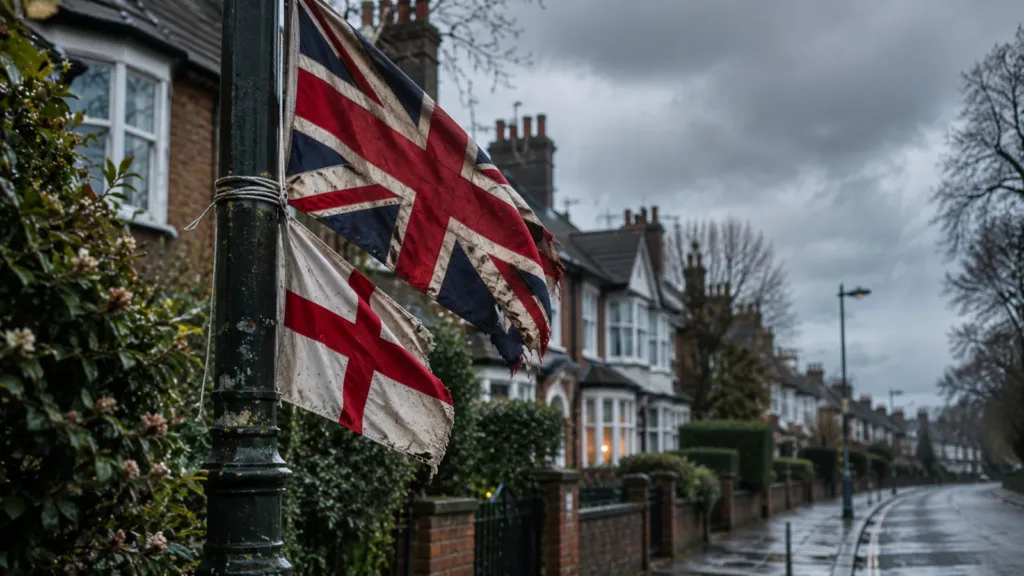
Raise the Colours is one of several groups behind what became known as Operation Raise the Colours, a campaign that emerged online in August 2025 with the stated aim of promoting national pride. Its supporters tie Union flags and St George’s crosses to lampposts and paint crosses on mini-roundabouts. Searchlight describes it as a “patriotic” mass-flagging campaign that began in and around Birmingham and Oxford and inspired copycat efforts nationwide.
The scale has been considerable. Birmingham City Council has estimated that around 20,000 flags were put up in the city, and a Freedom of Information response cited on the campaign’s Wikipedia entry found 36 local authorities had spent more than £61,000 removing them. Councils have split: some removed flags on safety grounds, others left them up or offered grants for official flagpoles.
Politically, it has been just as divisive. Kemi Badenoch called council removals “shameful”; Sir Keir Starmer said flags are patriotic but criticised their use for “divisive purposes”. Anti-racism groups including Hope Not Hate argue the campaign has far-right roots and is used to intimidate minority communities; supporters deny any racial motive. Our piece on what St George’s Day means to England explores why the national flag remains so contested.
Why it matters
For the O’Gara family, the verdict is about a man who went out for the evening over the late May bank holiday weekend and did not come home. It would be wrong to treat it as a verdict on a flag campaign, and the court deliberately did not. But Allison’s membership of Raise the Colours has inevitably drawn fresh attention to a movement that has spent more than a year at the centre of arguments about patriotism, public space and who gets to claim national symbols.
Sentencing on 5 January will be the next moment in the case. In the meantime, the debate about the flags themselves, in council chambers, courtrooms and on Britain’s lampposts, shows no sign of ending.