The Kerch bridge, the 19-kilometre road-and-rail crossing that links occupied Crimea to mainland Russia, has been struck three times in four days. Ukraine hit it on Monday 16 November, brought down a section of the road span in a second, heavier attack overnight into Tuesday 17 November, and struck again in the early hours of Thursday 19 November, halting rail traffic. Volodymyr Zelensky has called it an “unprecedented operation”; the Kremlin insists the bridge will be rebuilt “even better than before”.
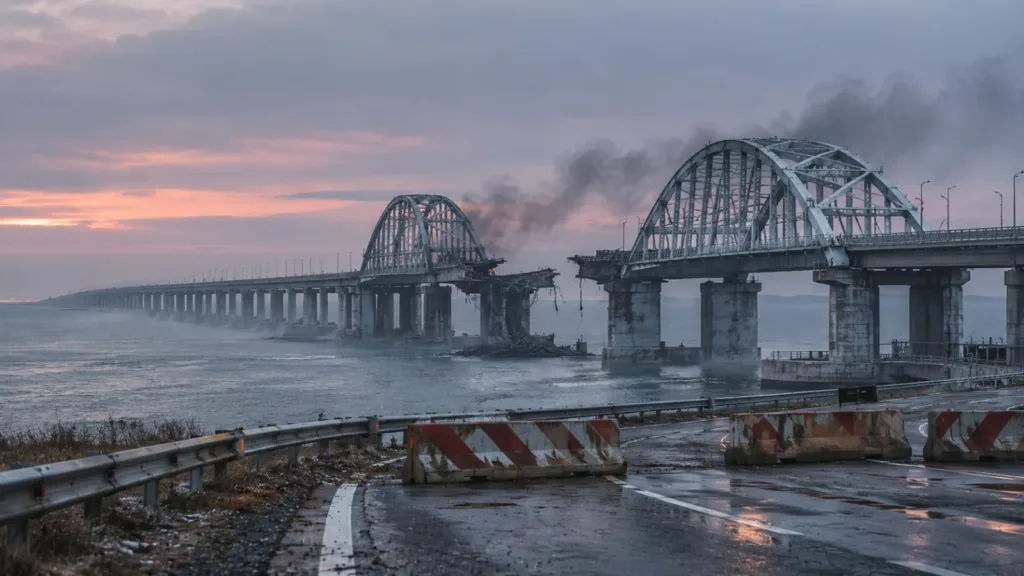
It is the most serious damage the crossing has suffered since it opened, and the first time in more than a year that Kyiv has successfully reached it. Here is what each side has said, and what can actually be verified.
What happened to the Kerch bridge this week?
The sequence, pieced together from official statements and reporting by ABC News, CNN, the Kyiv Post and the US defence site TWZ, runs as follows:
- Monday 16 November: a first strike damaged the main road span on the Kerch side. Russian television footage showed a deformed arch. Kremlin spokesman Dmitry Peskov described the damage as “minor”. Four passenger trains to Crimea were delayed by up to four and a half hours, according to the rail operator Grand Service Express.
- Overnight 16–17 November: a second attack, at around 1.30am local time, appears to have dropped the road span into the water. Sergei Aksyonov, the Moscow-installed head of Crimea, wrote on Telegram: “The enemy attacked the Crimean bridge again. Currently, traffic is suspended.”
- Thursday 19 November: a third strike stopped rail traffic. Aksyonov said “traffic has been temporarily suspended” and that “an assessment of the damage is underway”, adding that he expected trains to resume later the same day.
Satellite imagery and photographs published after the second strike show one of the two steel arches over the navigation channel missing from the road bridge. The parallel railway arch was still standing, though Ukraine’s General Staff said it had been damaged.
What does Ukraine say?
Zelensky confirmed the operation on social media, posting video apparently filmed from a munition heading for the bridge. He described the attack as “an unprecedented operation in response to Russian strikes on our infrastructure” and said it was the seventh stage of a campaign that had been running for several weeks. According to CNN, he stressed that only Ukrainian-made weapons were used.
ABC News reported that the strike involved drones and missiles, including a precision attack by an FP-5 Flamingo cruise missile. Fire Point, the company that makes the Flamingo, claimed its weapons caused “critical damage”, destroying nearly 900 feet of road surface and collapsing one of the two arches. That figure is the manufacturer’s own and has not been independently confirmed. Ukraine’s General Staff said the roadway was out of action.
What does Russia say?
Moscow’s line has shifted from dismissal to damage control. On Monday Peskov called the damage minor. By Tuesday, after the span came down, he told reporters, as quoted by the Kyiv Post: “There is no doubt that the bridge will be restored. And it will be even better than before.” He said Deputy Prime Minister Marat Khusnullin had briefed Vladimir Putin, and a government commission chaired by Khusnullin has been tasked with repairs.
Khusnullin told the state news agency TASS that individual sections could reopen “within one or two months”. Russia’s Investigative Committee has opened a criminal case under its terrorism laws, citing “damage to the structure”. The transport ministry said there were no casualties on the bridge itself. Separately, Aksyonov said two people had been killed in a drone attack in the Leninsky district near Kerch on Tuesday; it is not established whether that was linked to the bridge strikes.
Why does the Crimean bridge matter so much?
The bridge, which cost about $3.7 billion and was built to carry 40,000 cars a day, is Russia’s only direct land link to Crimea. Putin opened it personally in 2018, four years after the peninsula was annexed, and it has since become both a military supply artery and a political trophy. It was damaged by a truck bomb in October 2022 and by Ukrainian sea drones in July 2023; the SBU later acknowledged both operations, and in June 2025 claimed an underwater attack on its supports.
This time the damage appears more lasting. With the road deck down, heavy vehicle traffic must rely on the much smaller ferry crossing, which is itself exposed to attack. Krasnodar authorities said food and warming points had been set up for drivers stranded near the approaches, and Crimea already lived through a summer state of emergency over power cuts and fuel shortages.
How does it fit into the wider war?
The bridge strikes came during one of the heaviest exchanges of long-range fire of the war. Russia’s Defence Ministry said Ukraine launched more than 1,400 drones overnight into Tuesday, with Moscow’s four international airports briefly restricted. In return, Kyiv Mayor Vitali Klitschko said Russian ballistic missiles targeted the capital’s own Northern and Southern bridges over the Dnipro.
The timing is diplomatically loaded. Putin met Donald Trump on the sidelines of the APEC summit in Shenzhen this week, and Peskov did not rule out a link between the attacks and the talks. In Brussels, meanwhile, the Pentagon’s policy chief questioned the value of Ukraine’s deep strikes, prompting sharp rebukes from London and Berlin; we cover that row in our piece on Elbridge Colby and NATO. On Wednesday 18 November the UK said it would give Ukraine more than 1,000 long-range strike drones.
What happens next?
Three questions will decide how significant this week proves. First, how quickly Russia can restore even partial road traffic: Khusnullin’s one-to-two-month estimate is for individual sections, not the whole crossing. Second, whether the rail line, the bridge’s most important military function, can be kept running under repeated attack. Third, whether Kyiv’s claim of a multi-stage campaign means further strikes are planned; Zelensky’s framing suggests they are.
For now the verified picture is clear enough: a structure Moscow presented as untouchable has lost a span of its road deck, and Ukraine has shown it can reach it repeatedly with weapons of its own making.