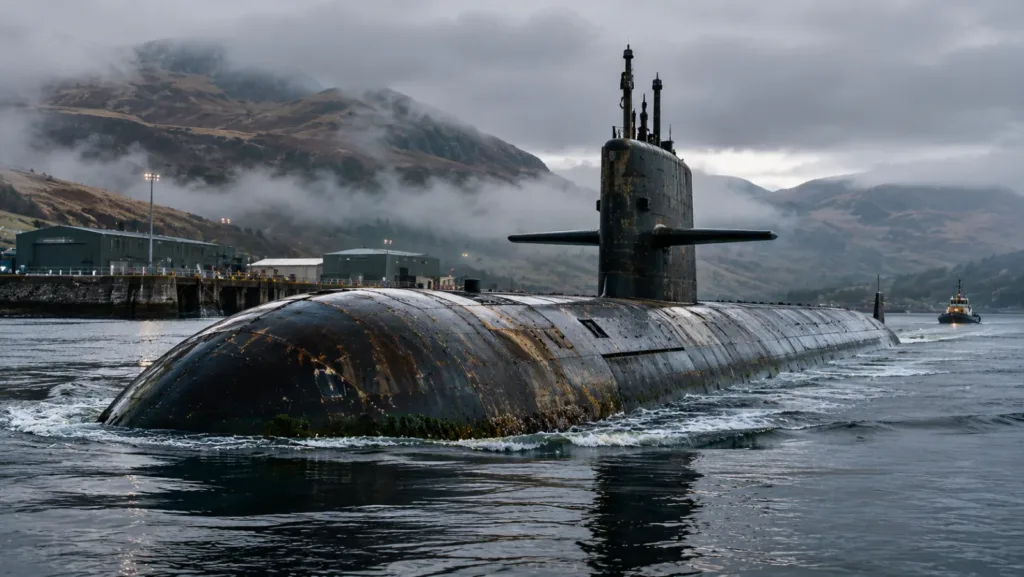
HMS Vengeance, one of the Royal Navy’s four Trident-armed submarines, came home to HM Naval Base Clyde at Faslane on Sunday 15 November after what open-source trackers put at 217 days continuously at sea, the longest British nuclear deterrent patrol on record. Days later, on Wednesday 18 November, BAE Systems, whose Barrow shipyard built her, confirmed plans to cut around 1,070 jobs, most of them in Lancashire. Two separate stories, but they say a good deal about the condition of British defence.
How long was HMS Vengeance at sea?
The Ministry of Defence never confirms the length of deterrent patrols. In a written answer last year it said that “such information could be used to undermine the security and capability of the mission”. The 217-day figure therefore comes from observers: a Vanguard-class boat was seen leaving Faslane on 12 April, and Vengeance was photographed returning up the Clyde on 15 November, as the UK Defence Journal reported.
If that is right, it beats the 205-day record set by HMS Vanguard, which returned only in April, and Vanguard’s 204 days the year before. BFBS Forces News reported that the patrol ran at least a week longer than planned because of a fault on the boat sent to relieve her, which had to return to Faslane for assistance.
Who welcomed the crew home?
Defence Secretary Wes Streeting and First Secretary of State Louise Haigh boarded the submarine to greet its roughly 140 crew. “The UK’s nuclear submariners are the ultimate national endeavour and the cornerstone of our national security,” Streeting said, praising crews whose “heroic service is the model of patriotism”. The First Sea Lord, General Sir Gwyn Jenkins, wrote that the submariners “have made enormous sacrifices to keep our nation safe”.
The photographs told a blunter story. Images of the returning boat show a hull thick with marine growth, rust streaks and missing patches of the rubbery anechoic tiles that help a submarine stay quiet. Tom Shugart, a retired US Navy submarine officer now at the Center for a New American Security, told TWZ she might be the “dirtiest, most sea growth-encrusted, and rustiest in-service submarine” he could recall, adding: “My hat is off to the team of sailors that managed to keep her out for that long.”
Why are Trident patrols getting longer?
Because there are not enough boats available. Operation Relentless, the continuous at-sea deterrent, has kept at least one nuclear-armed submarine on patrol every day since 1969, and it rests on four Vanguard-class boats commissioned between 1993 and 1999. Maintenance overruns have shrunk the pool: HMS Vanguard’s deep maintenance ran about four years late, delaying HMS Victorious in turn, which remains at Devonport. The longer the boats in service stay out, the more wear they accumulate, and the more maintenance they need when they return.
Their replacement, the Dreadnought class, is being built by BAE Systems at Barrow-in-Furness but is not expected to enter service until the early 2030s. The government says it will put £63 billion into the defence nuclear enterprise over four years, around £47 billion of it on submarines, maintenance and infrastructure.
What is happening at BAE Systems?
The second story is less about hulls than about payrolls. BAE has proposed cutting around 1,070 roles, about 2% of its UK workforce: roughly 940 in its air business and 130 at its London head office. ITV News reported that around 900 of the cuts would fall across the company’s Lancashire sites, Warton and Samlesbury, the centres of Typhoon production and work on GCAP, the next-generation fighter developed with Italy and Japan.
- The company says it will seek reductions through voluntary redundancy.
- Shopfloor manufacturing, aircraft maintenance, apprentices and early-career trainees are excluded.
- Barrow-in-Furness and the submarines business, including Dreadnought, are not expected to be affected.
A BAE spokesperson said: “We recognise that this news may be unsettling for our people,” adding that the company was “focused on achieving potential workforce reductions through a voluntary process”. The move comes despite a strong order book: BAE says it had secured £33 billion of orders in 2026 by 12 November and has raised its free cash flow forecast to around £3 billion.
Why are unions angry?
Unite’s general secretary, Sharon Graham, blamed slow government decisions rather than the company alone. “We won’t have a manufacturing industry left if the Government doesn’t start making critical decisions,” she said, calling for immediate orders for British-built Typhoons and collaborative combat aircraft, and accusing ministers of “a lack of joined-up thinking”. The argument resonates in Lancashire, where Typhoon production depends on export orders and the gap before GCAP is a persistent worry.
Why it matters
Put the two stories side by side and the pattern is hard to miss. Britain is spending more on defence than it has for a generation, yet its nuclear deterrent is being sustained by crews staying out far longer than planned, and its largest defence contractor is trimming staff in the very division that builds combat aircraft. The money is real; the speed at which it turns into boats, aircraft and secure jobs is the problem. As the Pentagon’s Elbridge Colby reminded European allies this week, Washington expects them to carry more of their own defence. Vengeance’s hull suggests how thin some of that capacity already is.