If you want the shortest possible answer to what defines Kate Middleton style in 2026, it is this: the Princess of Wales has moved even further away from “pretty royal dressing” and deeper into something more strategic. Her wardrobe this year has been built around disciplined rewears, British tailoring, diplomatic designer choices, heirloom jewellery and a growing confidence in using fashion not simply as decoration, but as a language of institutional meaning.
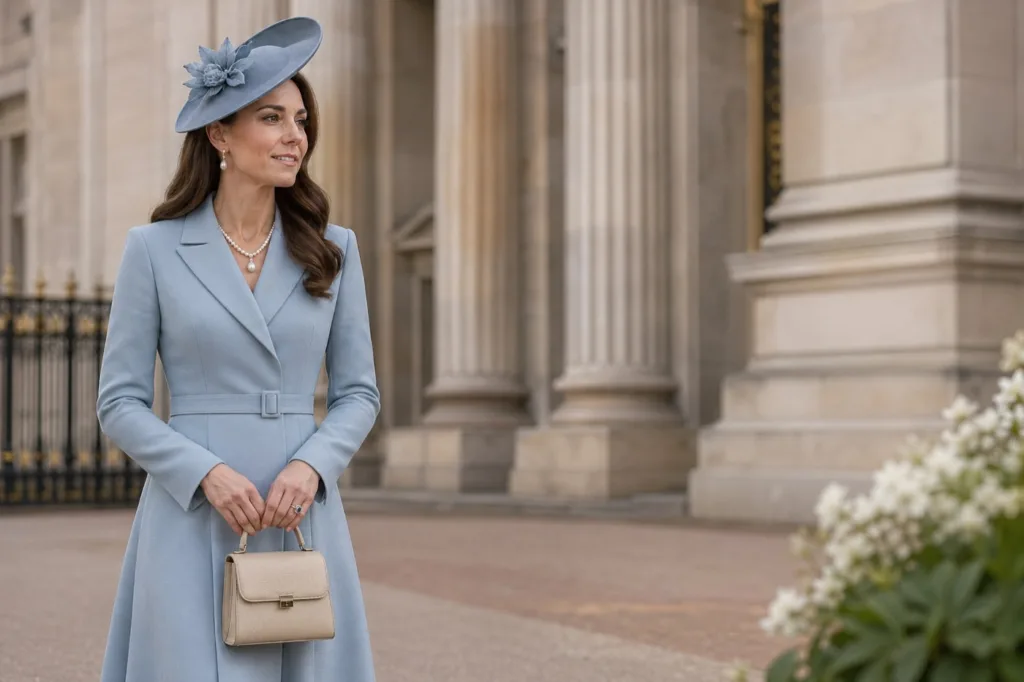
That is why the old phrase “the Kate effect” now feels slightly too small. In 2011, it mostly meant sold-out dresses and copied handbags. In 2026, the Princess of Wales effect is broader. It shapes retail interest, yes, but it also sets the tone of public occasions, rewards certain kinds of British polish, legitimises emerging designers when she chooses them, and reminds the wider culture that royal style still works best when it looks calm, coded and entirely in control.
What Kate Middleton style looks like in 2026
The pattern is unusually clear this year. Her 2026 wardrobe has not been about reinvention. It has been about refinement.
In January, for her first engagement of the year at Charing Cross Hospital, the Princess returned to a burgundy Roland Mouret suit, paired with a Me+Em pussy-bow blouse, DeMellier’s suede Hudson bag, Gianvito Rossi pumps and Cartier Trinity earrings. British Vogue described it as the kind of “hardworking staple” she wears on rotation, and that phrase gets to the heart of her 2026 mood. This is not trend-chasing style. It is repetition turned into authority.
At the 2026 BAFTAs, she wore a lilac Gucci gown from her own archive, first seen in 2019. That appearance mattered for more than red-carpet reasons. Vogue explicitly noted her “halo effect” on the BAFTAs dress code, arguing that the Princess of Wales changes the energy of the event simply by attending. That is the modern form of her influence: not just wearing a beautiful dress, but subtly recalibrating the level of polish around her.
At the Commonwealth Day 2026 service, she reached for a royal-blue Catherine Walker coat dress, a five-strand Susan Caplan pearl necklace and Queen Elizabeth II’s Bahrain pearl drop earrings, as detailed by British Vogue. On St Patrick’s Day, she leaned into an emerald green military-facing look as Honorary Colonel of the Irish Guards, which Vogue framed as another example of her being the queen of on-theme dressing.
Then came the most revealing shift of all. During the Nigeria state visit, she wore a grey-and-white coat by Tolu Coker, a British-Nigerian designer better known as a fashion-insider favourite than a standard royal mainstay. British Vogue rightly treated that look as a meaningful refresh rather than a simple outfit change. It was diplomatic, current and quietly bolder than much of her daywear tends to be.
And on Anzac Day, she wore a navy Sarah Burton for Alexander McQueen coat dress with white lapels, a Jane Taylor hat, Gianvito Rossi pumps, a DeMellier bag and sapphire-and-diamond earrings once owned by Diana, Princess of Wales. It was one of the clearest examples all year of how Kate uses clothing to perform remembrance, continuity and role inheritance in a single look.
The core brands in Kate Middleton’s 2026 wardrobe
If you want to understand the architecture of her style, start with the labels she trusts most.
Alexander McQueen remains foundational. The connection is now bigger than the wedding-dress legacy. McQueen gives her structure, discipline and a recognisably modern royal line. Whether she is wearing a burgundy coat in Wales or a navy military-adjacent look for Anzac Day, the brand offers what her public wardrobe depends on most: elegance with spine.
Catherine Walker still handles some of her most institutionally resonant appearances. Commonwealth Day proved again that Walker’s importance in the royal wardrobe is not nostalgic. The label delivers ceremonial clarity: sharp shoulders, precise colour, impeccable coat-dress logic.
Roland Mouret continues to matter in her working wardrobe because he gives her the most polished version of modern professional femininity. The January burgundy suit was not flashy, but it was exact. That is often when Kate is most effective.
Gucci is more occasional, but in 2026 it made sense at the BAFTAs. The rewear signalled glamour without novelty theatre. It also suggested that when Kate uses a global luxury house, she does so selectively and for context, not just for fashion-credit points.
Tolu Coker was perhaps the most interesting name she wore this year. The significance was not only aesthetic. It was about endorsement. A Princess of Wales outing can act like a cultural spotlight, and using it on a younger London designer with British-Nigerian roots made the outfit feel both strategic and fresh.
Then there is the supporting cast that actually helps define her silhouette day to day: Me+Em for polished separates, DeMellier for discreet luxury handbags, Gianvito Rossi for the dependable heel line she clearly trusts, Jane Taylor for hats that feel formal without feeling stale, and Susan Caplan for pearls that bridge vintage glamour and modern royal styling.
The signals inside the clothes
The Princess of Wales rarely dresses randomly. In 2026, her wardrobe has been sending a remarkably consistent set of signals.
Signal one: rewearing is now part of status, not a retreat from it. The BAFTAs Gucci dress and the January Mouret suit both reinforced this. Kate’s rewears no longer read as “thrifty” in the old tabloid sense. They read as editorially controlled. In other words, she is not repeating because she lacks options. She is repeating because certainty is part of the point.
Signal two: colour is political without becoming loud. Burgundy has become one of her defining shades this year. Emerald green appears when military or Irish symbolism is useful. Blue arrives for Commonwealth formality. Nigeria’s green appeared at the state banquet. Her palette is rarely random, and it is often more communicative than royal coverage likes to admit.
Signal three: jewellery is where memory is stored. Pearls, the Bahrain earrings, Diana-linked sapphires, the Lover’s Knot tiara at the Nigeria state banquet and repeated use of historic pieces all tell the same story. Kate’s jewellery choices are now one of the clearest ways she binds herself to both Queen Elizabeth II and Diana without ever saying so aloud.
Signal four: military and diplomatic dressing matter more than ever. St Patrick’s Day, Commonwealth Day, the state visit and Anzac Day all show the same instinct. She dresses not just for the camera but for the institution she is representing. That is why a coat, a brooch, a pearl earring or a shamrock can matter more in her wardrobe than a novelty silhouette.
Signal five: she is becoming slightly more fashion-literate in public. Tolu Coker was the clearest example. The look did not blow up her image system, but it introduced a subtle new note: the Princess can still surprise fashion people when she wants to.
The Princess of Wales effect in 2026
It is tempting to reduce the Kate Middleton effect to shopping behaviour, but that no longer captures the whole phenomenon.
Yes, the retail side still exists. A bag, coat or pair of earrings worn by the Princess of Wales still drives attention. But 2026 has shown a more developed version of her influence. She now affects dress codes, not just individual purchases. Vogue’s BAFTAs coverage made this point directly: her presence shapes how the rest of the room dresses.
She also affects brand legitimacy. When she wears Catherine Walker or McQueen, she reinforces a kind of royal orthodoxy. When she wears Tolu Coker, she confers something different: recognition from one of the most conservative style systems in public life. That is a very specific kind of cultural power.
And she affects how modern monarchy looks. This may be the most important layer of all. In 2026, her style suggests a future queen who understands visual messaging instinctively. She does not dress like a celebrity, even when she could. She dresses like someone building a visual constitution around herself.
What British women actually take from her style
The reason her wardrobe still lands so strongly in Britain is that it remains legible. The average reader is not buying a tiara, but she may absolutely buy into the principles behind the look.
- Repeat your best tailoring instead of chasing novelty.
- Use strong, single-colour dressing to create presence.
- Let accessories do the symbolic work.
- Build around a few dependable brands rather than endless rotation.
- Treat polish as a form of communication, not a superficial extra.
This is one reason the Princess of Wales has outlasted so many style cycles. She does not offer chaos. She offers coherence.
Interesting facts about Kate Middleton’s style in 2026
- At the 2026 BAFTAs, she rewore a Gucci gown first seen in 2019, reinforcing how central archive dressing has become to her public image.
- The Princess’s Commonwealth Day pearls came from Susan Caplan, showing that she still mixes royal heirlooms with vintage-fashion sourcing rather than relying only on palace-vault grandeur.
- Tolu Coker’s coat for the Nigeria state visit was one of Kate’s most fashion-insider choices in years and connected neatly to the King’s growing public support for British design talent.
- Her Anzac Day outfit echoed a 1995 Diana look closely enough that fashion coverage immediately read it as a deliberate intergenerational nod.
- The phrase “Kate effect” has evolved: in 2026 it means not just sell-outs, but the ability to shift how an entire public occasion is styled and perceived.
Final verdict
If 2025 was about the Princess of Wales returning visibly and carefully, 2026 has been about consolidation. The wardrobe is sharper. The messages are clearer. The mix of heritage, diplomacy and brand selection feels more controlled than ever.
That is why Kate Middleton style 2026 matters beyond royal fashion fandom. It is now one of the most sophisticated image systems in British public life: recognisable enough to reassure, strategic enough to signal, and selective enough to keep evolving without ever looking as though it is trying too hard.
The old story was that Kate wore nice coats. The real story in 2026 is that the Princess of Wales has turned clothes into one of the monarchy’s most effective soft-power tools.
FAQ
What brands does Kate Middleton wear in 2026?
Her core 2026 labels include Alexander McQueen, Catherine Walker, Roland Mouret, Gucci, Tolu Coker, Me+Em, DeMellier, Gianvito Rossi, Jane Taylor and Susan Caplan.
Why is Kate Middleton’s style so influential?
Because it combines accessibility, consistency, symbolism and institutional authority. Her clothes do not just look polished; they shape the tone of public events and drive attention toward specific brands and designers.
What is the Princess of Wales effect?
In 2026, it means more than sold-out fashion items. It describes her broader ability to influence dress codes, brand prestige, media narratives and the visual identity of the modern monarchy.
What is Kate Middleton’s most important style move in 2026?
Probably the shift from simple repetition to highly strategic rewearing. Her archive looks now read as confidence and control rather than caution.
What jewellery defines her 2026 style?
Pearls, Queen Elizabeth II heirlooms, Diana-linked sapphires and the Lover’s Knot tiara have all been central to her image this year.