If you are searching for the exact Trooping the Colour 2026 date, the practical answer comes first: the King’s Birthday Parade will take place on Saturday, June 13, 2026 at 10:00am on Horse Guards Parade, according to the official Household Division listing. The two preceding Saturdays, May 30 and June 6, are reserved for the Major General’s Review and the Colonel’s Review.
That is the diary answer. But the more interesting answer is that Trooping the Colour is never just a date on the royal calendar. It is one of the last British state occasions that still operates as military ceremony, family theatre, fashion signal and constitutional image-management all at once. It gives the public a parade, the Armed Forces a showcase, the monarchy a balcony moment and the fashion world one of its most revealing pieces of royal semiotics.
When is Trooping the Colour 2026?
The main parade falls on Saturday, June 13, 2026. The official event page from the Household Division confirms all three 2026 dates:
- May 30, 2026: Major General’s Review
- June 6, 2026: Colonel’s Review
- June 13, 2026: The King’s Birthday Parade
That matters because many people search for “Trooping the Colour” as if it were a single event, when in reality the full ceremonial machine is exercised across three consecutive weekends. The final Saturday is the one that matters most to the wider public, because it is the full state-facing version with the royal procession, the salute, the return to Buckingham Palace and the RAF fly-past.
What exactly is Trooping the Colour?
At one level, it is the official public celebration of the Sovereign’s birthday. At another, it is a military tradition with deep practical origins. The official history from the Household Division explains that regimental colours once acted as battlefield rallying points. Troops needed to recognise their regiment’s flag quickly, so the colours were marched through the ranks in a process that eventually gave the ceremony its name.
Today, that old battlefield necessity has become pageantry, but it has not become empty. The Royal Family’s own explainer notes that the event still brings together more than 1,400 soldiers, around 200 horses and more than 400 musicians. That scale is part of the point. Trooping the Colour is one of the monarchy’s clearest demonstrations that symbolism, when choreographed properly, can still feel like power.
Why is the King’s birthday parade in June if King Charles was born in November?
Because the official birthday is not the same as the biological one. King Charles III was born on November 14, but Trooping the Colour takes place in June because Britain long ago settled on a separate ceremonial birthday for the Sovereign.
According to the Household Division’s history page, the parade was first used to mark the Sovereign’s official birthday in 1748 and became an annual event after George III came to the throne in 1760. In other words, this is not a quirk of Charles. It is an old institutional workaround, and a sensible one: June is simply a better month than November for horses, scarlet tunics, fly-pasts and massed public spectacle.
The Buckingham Palace balcony: why it matters more than people admit
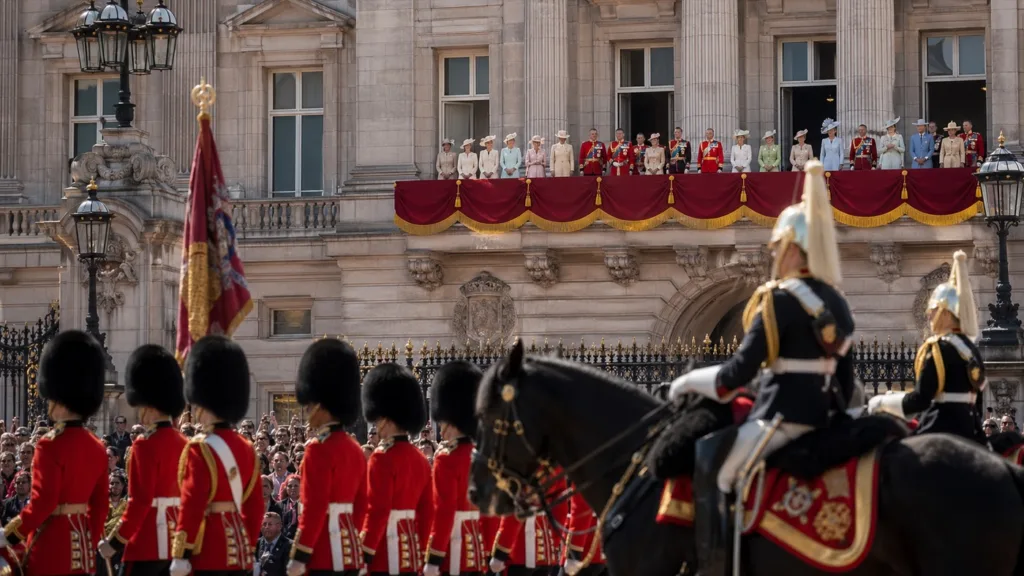
The balcony is not an afterthought. It is the image that most people remember.
After the parade returns to Buckingham Palace, members of the Royal Family gather to watch the RAF fly-past. The Royal Family’s official guide describes that moment as the closing image of the day, and in media terms it is the most potent part of the whole ritual. The balcony tells the public who is in, who is visible, who is trusted and how the working monarchy wants to present itself.
As of April 27, 2026, the exact Trooping the Colour 2026 balcony lineup has not been formally published. But recent precedent is clear enough to guide expectations. In the official 2024 and 2025 royal reports, the visible pattern is a working-royals model rather than a sprawling family tableau.
That means the real balcony story is not just “who waves.” It is how monarchy edits itself. Trooping the Colour has become one of the monarchy’s most efficient annual acts of visual curation.
Who is most likely to dominate the fashion conversation in 2026?
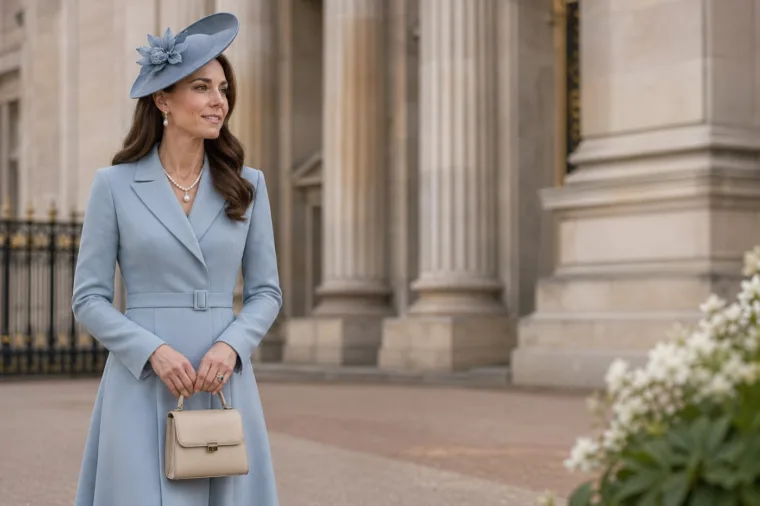
The obvious answer is the Princess of Wales, because Trooping the Colour has become one of the few royal events where her wardrobe choices are still read as public language, not mere occasion dressing.
British and American Vogue both highlighted her recent track record. In 2025, British Vogue noted that she wore an aquamarine Catherine Walker coat dress with ivory detailing, a Juliette Botterill hat and the Irish Guards regimental brooch. In 2024, Vogue focused on the symbolism of her Jenny Packham look at a moment when her appearance itself carried extra public meaning.
That is why Trooping fashion matters. Royal dressing here is rarely random. It usually works through five codes:
- Visibility: bold, clean colour that reads from a carriage, a dais and a balcony.
- Continuity: heritage designers such as Catherine Walker, Jenny Packham or Alexander McQueen.
- Military reference: brooches, regiment colours and tailoring that speak to service culture.
- Hierarchy: hats, coats and silhouettes that respect the formality of the parade.
- Family coordination: especially between the Princess of Wales and Princess Charlotte, where tonal echo has become a reliable visual strategy.
The best royal fashion to watch for in 2026
If you want the smart fashion angle rather than the lazy slideshow one, these are the figures to watch.
The Princess of Wales remains the key style barometer because Trooping the Colour is one of the clearest stages on which she performs monarchy through dress. Her best looks at this event are not only elegant; they are legible. They tell the crowd and the cameras exactly where to look.
Queen Camilla often works through cream, white or pale neutrals, military brooches and formal hats. In 2024, the Royal Family’s official report noted her Grenadier Guards brooch, a reminder that small accessories can carry institutional meaning.
Princess Charlotte matters more than many editors admit. At Trooping, she is not styled as a miniature adult but as part of a family image system. In 2025, fashion coverage repeatedly noted how closely her palette echoed her mother’s.
The Duchess of Edinburgh is often the quiet success of the day: polished, camera-friendly and less over-analysed, which sometimes makes her one of the more consistently effective dressers at large royal events.
And then there is the men’s side, which works differently. At Trooping, military uniform is the fashion language. Prince William, Princess Anne and the Duke of Edinburgh have all recently appeared on horseback in regimental uniform, as confirmed by the official 2025 palace summary. In this setting, tailoring is not trend; it is rank, allegiance and ceremonial grammar.
Why Trooping the Colour still matters in 2026
Because it is one of the few surviving British rituals that still manages to speak in several registers at once.
It is a military parade, and not in a decorative sense. The 2024 royal account made a point of stressing that many of the soldiers on parade are young, recently trained and fully operational. It is also a constitutional tableau, in which monarchy is shown not as abstraction but as choreography: Crown, service, nation, family, order.
And it is a fashion event, though royal traditionalists sometimes pretend otherwise. Clothes are part of the message because image is part of statecraft. A monarchy that appears in public this rarely cannot afford to dress without meaning.
That is why the ceremony still draws fascination well beyond royal-watchers. Trooping the Colour is one of the last occasions where Britain stages itself with complete seriousness and still expects millions to watch.
Interesting facts about Trooping the Colour
- The ceremony has marked the official birthday of the British Sovereign for more than 260 years, according to Royal.uk.
- The parade uses 113 words of command, according to the Household Division.
- A 41-gun salute is fired in Green Park during the ceremony.
- The full spectacle is effectively staged three times across three consecutive Saturdays, not once.
- The event is sometimes described by the palace as a “gift” from the Household Division to the Sovereign, a detail included in the 2024 official royal write-up.
How to watch Trooping the Colour 2026
If you want the full ceremonial version in person, the official route is through the Household Division, which publishes details for the Horse Guards stands and the review dates. If you want the simplest option, the Royal Family’s official explainer says the event is also broadcast live by the BBC.
For most people, the key watch points are obvious: the procession down The Mall, the parade itself, and the Buckingham Palace balcony with the RAF fly-past.
Final word
If you want the sharp answer, here it is: Trooping the Colour 2026 takes place on Saturday, June 13; the exact balcony lineup has not yet been officially confirmed as of April 27, 2026; and the royal fashion conversation will almost certainly centre on the Princess of Wales, Queen Camilla and the visual discipline of the working monarchy.
If you want the more serious answer, Trooping the Colour still matters because it does something very few public rituals can still do. It turns history into live image. It makes military tradition intelligible to mass culture. And for one June morning, it reminds Britain that pageantry is not only about nostalgia. It is also about control, continuity and the art of being seen.
FAQ
When is Trooping the Colour 2026?
The King’s Birthday Parade takes place on Saturday, June 13, 2026, with the Major General’s Review on May 30 and the Colonel’s Review on June 6.
What time does Trooping the Colour 2026 start?
The official Household Division listing gives the start time as 10:00am.
Who will be on the Buckingham Palace balcony in 2026?
As of April 27, 2026, the exact lineup has not been officially published. Recent years suggest a working-royals-focused appearance rather than a full extended-family grouping.
Why is Trooping the Colour held in June?
It marks the Sovereign’s official birthday, a tradition linked to better summer weather and formalised in the eighteenth century.
Why is Trooping the Colour important?
It combines military tradition, royal ceremony, constitutional symbolism and one of the monarchy’s most powerful annual public images: the Buckingham Palace balcony.
What should I watch for in the royal fashion this year?
Watch for strong single-colour dressing, military brooches, heritage British couture houses, coordinated family styling and the way formal daywear is used to express rank, continuity and public meaning.